

What Is a Prorated Rent Calculator and Why It Matters in California


Using a prorated rent calculator in California is one of the fastest ways to figure out exactly what you owe — or what you’re owed — when a lease starts or ends mid-month.
Here’s the quick answer:
Prorated rent = (Monthly Rent ÷ Days in the Month) × Days Occupied
For example, if your rent is $2,400/month and you move in on August 10th (31-day month):
StepCalculationResultDaily rate$2,400 ÷ 31$77.42/dayDays occupiedAug 10 – Aug 3122 daysProrated rent$77.42 × 22$1,703.24
That’s where proration comes in. It’s the fair way to charge — or pay — only for the days you actually live in a unit.
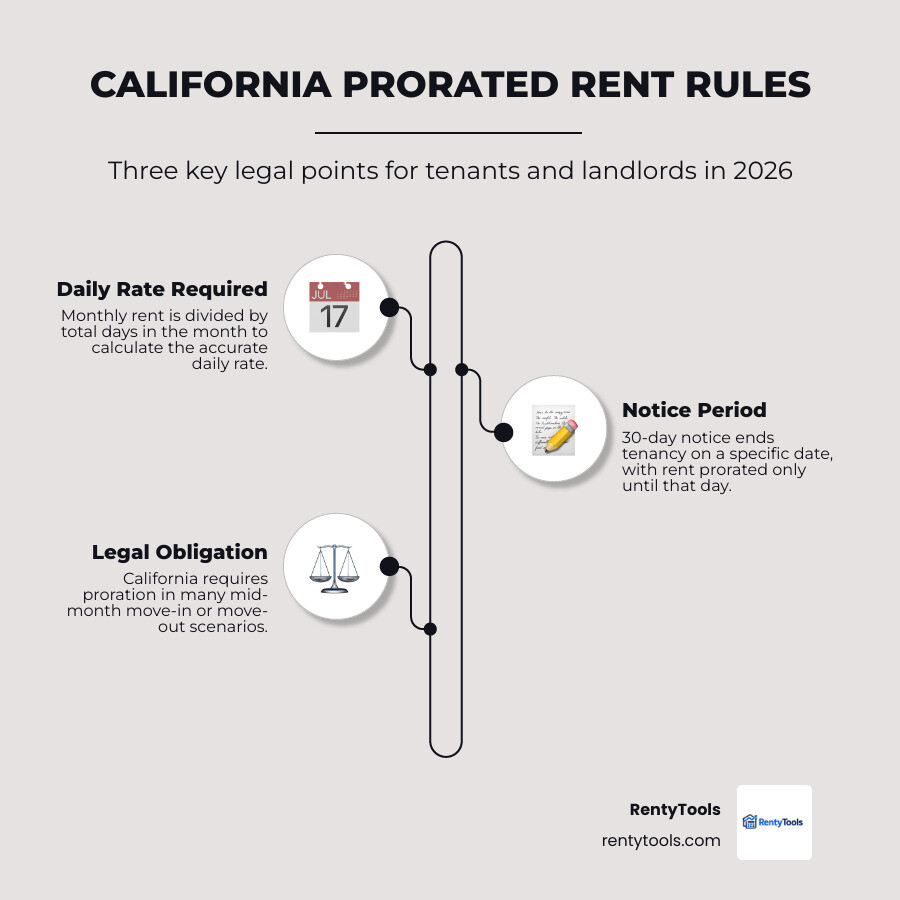
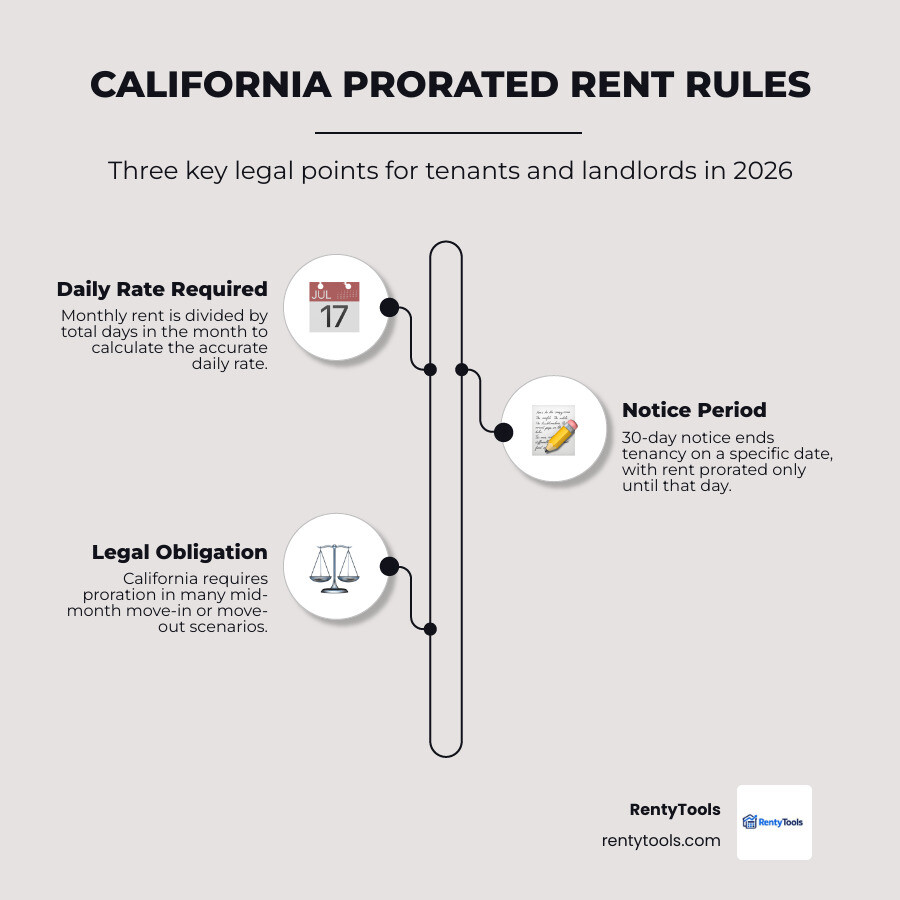
California is one of only 3 states where daily-rate proration is legally required in certain situations, not just standard practice. That makes getting the math right even more important here than in most other states.
Understanding California Prorated Rent Laws in 2026
When we talk about renting in the Golden State, the rules are a bit different than in most of the country. As of May 2026, California remains one of the most tenant-friendly states, and its stance on proration is quite clear. While many states treat prorating as a “nice to do” industry standard, California law often makes it a “must do.”
California Civil Code § 1950.5 and Tenant Rights
While California Civil Code § 1950.5 focuses heavily on security deposits, it sets the stage for “itemized statements.” If a landlord overcharges for a partial month, it can complicate the final accounting of the security deposit. California courts have historically favored the “actual days” method of calculation because it is the most mathematically precise way to ensure neither party is unfairly enriched.
AB 1482 and Mid-Month Increases
The Tenant Protection Act (AB 1482) also plays a role in how we look at rent. If a landlord implements a rent increase that takes effect mid-month, that month’s rent must be split. You would use our Prorated Rent Calculator to find the daily rate for the first half of the month at the old price and the daily rate for the second half at the new price.
How to Use a Prorated Rent Calculator California Method
Calculating rent for a partial month might feel like high school algebra all over again, but we promise it’s simpler than it looks. The goal is to find the “daily rate”—the cost of living in the unit for exactly 24 hours.


The Formula Breakdown
To get an accurate result, we follow this logic:
- Identify Monthly Rent: The total amount due for a full month.
- Count Days in the Month: 28, 29, 30, or 31.
- Calculate Daily Rate: Monthly Rent ÷ Total Days in Month.
- Determine Occupancy: Count every day the tenant has possession of the keys, including the move-in day.
- Final Total: Daily Rate × Days Occupied.
Understanding Why Prorated Rent for the First Month Can Save You Real Money is essential for tenants on a budget. If you move in on the 25th of a 31-day month, you shouldn’t be paying for the 24 days the unit sat empty!
Step-by-Step Guide for a Prorated Rent Calculator California Calculation
Let’s run a real-world scenario. Imagine it’s May 2026. You’ve found a beautiful apartment in San Diego for $3,000 a month. You are scheduled to move in on May 12th.
Step 1: Determine the total days in May. May has 31 days.
Step 2: Calculate the daily rate. $3,000 ÷ 31 = $96.7741 (We recommend keeping at least four decimal places during the calculation to ensure accuracy, then rounding at the very end).
Step 3: Calculate days of occupancy. Since you move in on the 12th, you are living there from the 12th through the 31st. Calculation: (31 – 12) + 1 = 20 days. Tip: Always add “+1” when subtracting dates to ensure the move-in day itself is counted!
Step 4: Multiply. $96.7741 × 20 = $1,935.48.
By using our suite of Rent Calculators, you can avoid the “finger-counting” method and get a professional breakdown to show your landlord.
Comparing the 30-Day Banker’s Method vs. Annual Method
Not all landlords use the calendar days method, though in California, they probably should. Here is how the different methods stack up for a $3,000 rent move-in on March 15th:
MethodLogicDaily RateTotal (17 Days)Calendar DaysRent ÷ 31 (Actual days)$96.77$1,645.0930-Day Banker’sRent ÷ 30 (Always 30)$100.00$1,700.00Annual Method(Rent × 12) ÷ 365$98.63$1,676.71
The 30-Day Banker’s Method is common in commercial real estate and some older residential leases. However, it creates “systematic inequities.” For example, in a 31-day month, the landlord gets a slightly higher daily rate than they technically should. In California, if a dispute goes to court, judges almost always lean toward the Calendar Days method because it reflects the actual reality of the calendar.
The Annual Method is the most precise for long-term leases, as it accounts for the entire year’s cost spread across 365 days. However, it’s rarely used for simple mid-month move-ins because it’s slightly more complex to explain to a tenant.
Move-In vs. Move-Out: When Should Landlords Prorate?
Proration isn’t just for the start of a lease. It’s a vital tool for the end of the journey, too.
Mid-Month Move-Ins
Most landlords prefer leases to start on the 1st. If a tenant wants to move in on the 10th, the landlord has two choices:
- Start the lease on the 10th and make the 10th of every month the “rent due date.” (This is a logistical nightmare for most).
- Start the lease on the 10th, prorate the first month, and then have the full rent due on the 1st of the following month. (This is the industry standard).
Mid-Month Move-Outs
This is where things get tricky. If a tenant has a fixed-term lease that ends on July 31st, but they decide to leave on July 15th, they are generally still responsible for the full month of rent unless the landlord finds a new tenant to move in early.


Before committing to a new place mid-month, it’s always a good idea to check your budget with a Rent Affordability Calculator to ensure the move-in costs (which often include a full security deposit plus prorated rent) fit your 2026 financial goals.
Common Mistakes and Tenant Rights in California
Even with the best intentions, mistakes happen. Here are the most common pitfalls we see in California rentals:
- The “February Trap”: Landlords often forget that February has fewer days, which makes the daily rate higher. If they use a 30-day average for February, they are actually undercharging the tenant.
- Prorating Security Deposits: Never prorate a security deposit. In California, the maximum security deposit is based on the total monthly rent (usually capped at one month’s rent for unfurnished units as of recent 2024/2025 legislative changes). Even if the tenant only stays for 5 days, the deposit is a fixed amount held for damages, not a time-based fee.
- The Move-In Day Mismatch: Does the tenant get the keys at 8:00 AM or 8:00 PM? Generally, the day the tenant receives the keys and has access to the property counts as a full day of occupancy.
Tenant Rights and Small Claims
If a landlord refuses to prorate rent when legally required, or uses a math method that overcharges you by hundreds of dollars, you have recourse. California’s Small Claims Court limit is $12,500. Before filing, however, we always recommend sending a formal demand letter.
California also has strict protections against landlord retaliation. If you point out a mathematical error in the proration calculation, the landlord cannot legally “punish” you by rescinding the lease offer or increasing other fees. For more information on how to handle these disputes, the California Courts Small Claims Guide is an invaluable resource.
Verifying Your Totals with a Prorated Rent Calculator California Tool
Tenants should always double-check these numbers. Using a tool like RentyTools ensures that both parties are looking at the same objective data. Keep a copy of your calculation and the receipt for the prorated payment for at least four years—this is the standard window for IRS audits and potential legal disputes.
Frequently Asked Questions about California Rent Proration
Is prorated rent legally required in California?
Yes and no. It is not strictly mandatory for the start of a lease unless specified in the contract (though it is standard practice). However, it is mandatory for residential tenancies when a tenant terminates with proper notice, or if a landlord-initiated change (like a repair delay) prevents the tenant from moving in on the agreed date.
How do I calculate rent for a move-out mid-month?
Count the number of days from the 1st of the month until your legal move-out date (the day your notice expires). Divide your monthly rent by the total days in that specific month to get the daily rate, then multiply by your days of occupancy.
Can a landlord refuse to prorate the first month?
Technically, a landlord can insist that a lease begins on the 1st. If you choose to move in on the 5th, they can charge you for the full month. However, in the competitive California market, most landlords offer proration to fill vacancies faster. If they refuse, you can try to negotiate, but ensure the final agreement is in writing.
Conclusion
At the end of the day, calculating rent shouldn’t be a source of stress. Whether you are moving into a studio in San Francisco or a house in Fresno, the principle remains the same: you should pay for the time you use.
Using a prorated rent calculator in California ensures that the math is fair, legal, and transparent. For landlords, it builds rapport and trust with new tenants from day one. For tenants, it keeps more money in your pocket for moving expenses and furniture.
Ready to crunch the numbers? Use our free Prorated Rent Calculator to get an instant, accurate breakdown of your partial month’s rent today. At RentyTools, we’re here to make the financial side of renting simple, so you can focus on making your new space feel like home.